

So, it seems it’s that time of the year again: another rumor of a Red Dead game in the works, and allegedly titled, “Red Dead Redemption 2: Legends of the West”. It really has become a bit of an annual tradition since Redemption’s release in 2010. Someone, somewhere, on some gaming site or blog swears they have insider information about another installment in the works, and that we’ll have details in the foreseeable future. It’s not like it’s a far-fetched notion. Redemption did phenomenally well – I rank it as within the top three of my personal top ten of all time, so you can probably guess how strongly I feel about its quality. And of course, Rockstar Games has indicated that it considers Red Dead a “permanent franchise” like Grand Theft Auto, so there will, in theory, be more installments to come. Of this, I have no real doubt.
Still, there’s been neither hide nor hair of any real, verified details about development of a successor to Redemption, and with the number of alleged confirmation sightings so far leading to nothing, I have kept my guard up. I hate coming down from the high of expectation. Shortly before writing this post, I discovered that someone at Forbes has since published an article offering, shall we say, considerable doubt about the FragHero piece’s content. I’m sure it’s not the only such article out there as of this latest round of rumor mill buzzings, though I have wondered if a lot of people have just stopped giving any energy to addressing these kinds of recurring claims.
Of course I would love another Red Dead Redemption game, as long as it retained the spirit and richness of Redemption’s experience. I actually was lucky enough to score a copy of Red Dead Revolver on PS2, way back when it first was released. I say that, because I hear from interested friends these days that it’s since become more difficult to find for purchase. I loved the quirky, campy, and just downright fun of Revolver. It is very different from the gravity and enduring harshness of Redemption, but I do not at all feel that it suffers for that distinction. Where Revolver happily and easily riffs on the “Spaghetti Western” genre, Redemption is something much more akin to a Shakespearean tragedy. Similarities to Rockstar’s GTA franchise can indeed be found in some aspects. Overall, though, Red Dead Redemption is one of their greatest creative triumphs, and they should certainly be wary of releasing successive installments unless they meet the now very high established standard.
What makes Redemption so thoroughly impressive, and awe-inspiring, is the way in which it leverages all of its assets: a compelling story, an immersive environment, unforgettable characters, and a stunningly gorgeous soundtrack. It is not often that a game captures my imagination and keeps me so hopelessly engrossed.
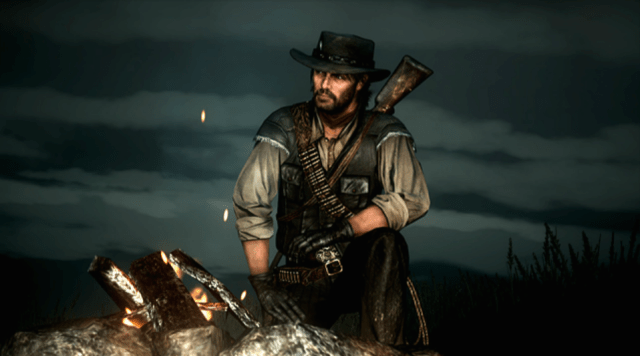
The story of John Marston is simple enough at first glance: a former outlaw finds himself in a new and equally unforgiving era, which demands him to confront the scattered specters of his past to save his future…his family. The “good guys” in suits and badges have given this ultimatum, and they struggle mightily even to feign the tiniest shred of sympathy. Theirs is a world of so-called order, of established hierarchy and tactical cruelty with simultaneous crowing about lawful decency. This hypocrisy is reflected often over the course of the story. And it does very well to endear Marston to us further. The philosophical implications of doing what one must to survive, and to ensure the survival of loved ones, are pondered in many contemporary media. But I think the game handles this, and other questions rather deftly, leaving us with an ending that is not so much a resolution but a continuation of the main question. The central storyline’s final events leave us shocked, sorrowful, maddened, and bloodthirsty…and in this way we acutely experience the emotions of a key character. The story is compelling, and heartbreaking. And it stays with you long after you have played it through.
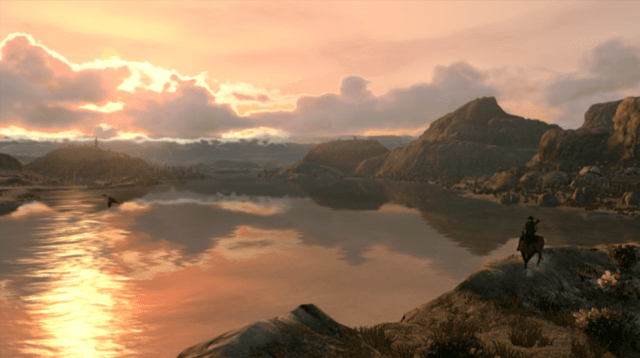
Redemption’s environment is also a great boon to its overall presentation. The year is 1911. The final ragged edges of a shrinking map are on full and vivid display. The Old West of the latter half of the 19th century, as it is often depicted and romanticized, is fading. The advent of new technology and “civilization” has created a new reality for those who knew little more than how to scrape out a life in its violent heyday. And America surges forward in its advancements (civilian and martial) and increasing development of rugged frontier lands. The breathtaking terrain dotted with settlements often connected by rail signals these changes, the creeping modernization. Despite this, when you’re out riding alone at night, it is easy to become lost in the desolate nature of your surroundings. Distant coyotes howl, birds of prey flap overhead, and big cats stalk the grasslands. The whistle of trains is an interesting contrast to the sounds of nature. You never quite know whether the approaching galloping is that of a friend, foe, or neutral party. And you learn pretty quickly that the environment itself is conducive to a unique experience.

The characters, too, are absolute gems. They are all markedly different in their personalities, their motivations, and their calculations of the world they inhabit. To my reckoning, no major character is representative of a singular archetype: no, quite the contrary. All of them are multidimensional, shaded with the nuances of lives hard-lived. Not all of them are perhaps helpful or otherwise benevolent toward our protagonist, John Marston. But they all arrive with believable baggage, with assumptions and quirks that make them capable of relating to, and sympathetic to varying extents, regardless of their position as helper or hinderer. From Bonnie MacFarlane, the headstrong rancher, to Captain De Santa, the duplicitous army officer, the intrigue is strong within each individual. For me, even the ones we are meant to loathe wind up leaving behind some semblance of humanity that is understandable, as twisted and broken as it might be. Everyone John Marston encounters has a story; whether we hear all of it or not is a variable. But each character has reasons why they are the way they are. And we may well find some pity for their plight, even as they try to destroy us (or not). It is the renewed realization of personal survival that compels sympathy, and reminds us that each one of the people that John meets is existing in accordance with the terms of their reality. They each must do what is required to stay alive. And such necessity often yields unpleasantries. I should add that the game’s voice acting is also quite notable for its quality, and this helps brings the characters to life in a way that charms and engages us, and keeps us mesmerized well beyond the very last credits’ roll.
Finally, the musical compositions of this game are striking, and, in my opinion, incomparable. The strings and percussion seem to shift in tone with the changing weather conditions and bleakness of the area. I have read that the soundtrack itself was created with the help of instruments common to the story’s era, and that helps immensely in enhancing the overall atmosphere and its authenticity. The horns heard while within Mexico’s borders have a sad quality to them, despite the vibrancy of their sound. I have found myself running around and lingering in Nuevo Paraiso for hours just to listen to the area’s captivating ambient music, which is only amplified in its power to entrance and unsettle with its beautifully twisted horns during the “Undead Nightmare” DLC campaign. And no one can possibly forget their feelings upon their first arrival in Mexico, after wily Irish goes his own way, and you’re left to embark upon lead-finding in this new land. The moment that Jose Gonzales’ song “Far Away” begins playing as you make your way into Mexico is a transformative one, and it really gets at your soul whether you mean to let it or not. I can remember the chills it gave me, the thrilling trepidation of uncertainty, of realization that I, as John, truly was alone in my quest. There is so much emotion packed in those moments, and it’s almost impossible to describe. I’ve not experienced a game that utilized a song to such emotional depths since perhaps one of the Legend of Zelda or Final Fantasy titles. The soundtrack, an inextricable part of Redemption’s magic, is likewise a triumph by Bill Elm and Woody Jackson. And I will never be able to listen to any of the tracks without recalling all of the places I’ve traveled and all of the people I’ve met in that world. Like every other aspect of the game, it all quite stubbornly sticks with you.
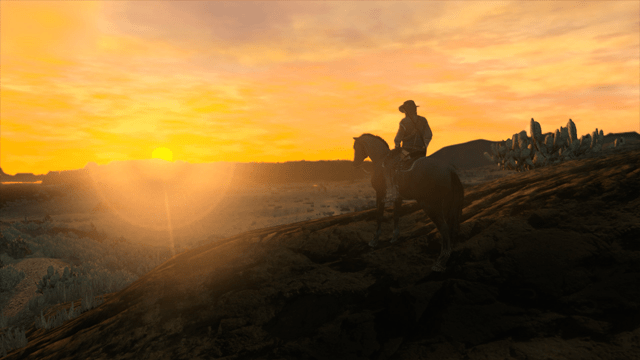
Red Dead Redemption is the rarest of specimens in terms of powerful, moving, and handsomely rendered video games. Everything about it still has me utterly bewitched, and reflective. It may not be a story with the most optimistic of endings, but the philosophical considerations are just as alluring to me as the gameplay. I, personally, have not played another game quite like it. It’s one of the greatest ever created, and I will continue to assert as much. If you have not played it yet, you simply must. If you have played it, and adore it as I do, play it again. The little details you notice each and every time you resume the story will astound you. They certainly astound me.

 POIETRIA.COM