
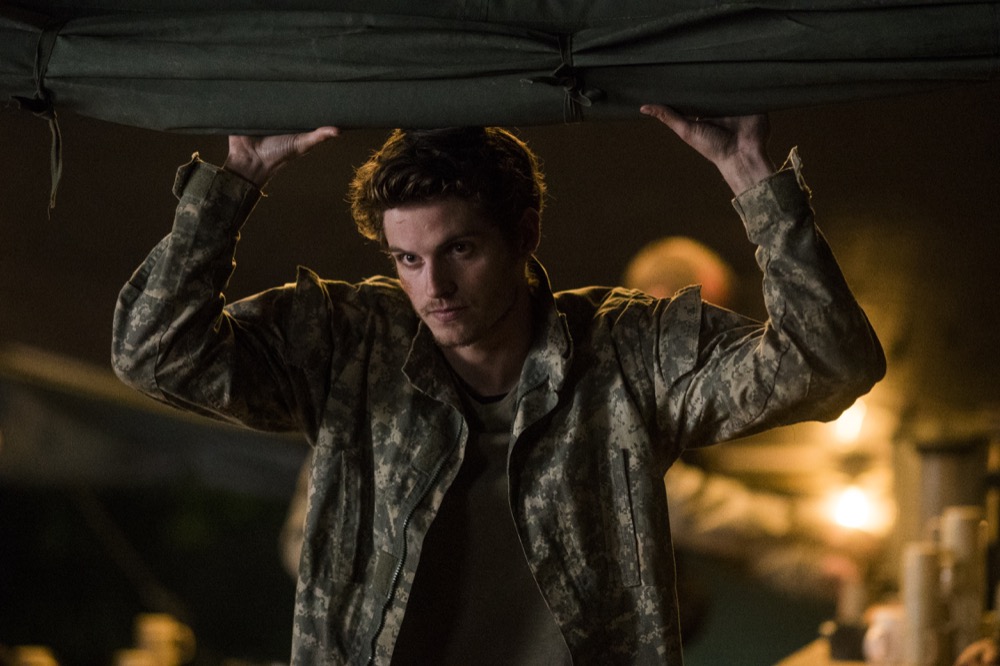
READER WARNING: This post contains spoiler content for the Season 3 Finale of AMC’s Fear the Walking Dead.
An open letter to the Fear the Walking Dead Showrunners and Writers Past and Present:
I first wish to congratulate everyone on a riveting third season. Every single person involved should be immensely proud. And it’s because I’ve enjoyed this season so thoroughly that I have written this piece.
I don’t often allow myself to become invested in characters on shows like The Walking Dead, or in this case, Fear the Walking Dead. It’s not just because apocalyptic settings are naturally perilous. Frankly, it’s more that my predilection for the complex antagonists and antiheroes leads me to mourn nearly as often as I become attached. But every now and then, I sense that maybe, just maybe this one will get more time, time to continue their journey as highly contributing figures in the narrative. My latest heartbreak has come in the apparent death of Troy Otto during the season three finale. His demise was emotional, abrupt, and extremely disheartening. I am genuinely in mourning both for his character, and his dynamic with Nick – and I suspect I will be for a long time to come. Yes, I am serious.
I’ll begin by saying that this piece is not about excusing or diminishing his character’s atrocities, or lobbying that he (or any other character) be granted impenetrable plot armor. What this letter is about is touching on key areas in which Troy had very promising room to grow, and what numerous intriguing questions could have been fascinatingly answered by his continuation to next season. As of the time of writing this, it appears that his character is as dead as anyone can be, and no amount of magical plot dust will change that. However, I would love nothing more than to be wrong about that! So by all means, if there is any magic to be found, any sort of creative wizardry, please, please treat him to it. I think I speak for a lot of people in saying that. Regardless, it was important for me to get these words down. If nothing else, I wanted to give some sort of tribute to the one who had become my favorite Fear character. But if it doubles as a case for his unexpected but much-desired return in Season 4, all the better.
I. Troy’s character exhibited notable potential for continued growth
I’ll put it bluntly: Troy’s story feels painfully unfinished. Over the last several episodes, we are shown the start of what appears to be a personal progression: who he was becoming away from the Ranch, and as he grew closer to Nick. They both were leaving clear marks upon each other, and if the loss of Troy is as final as it appears to be, I suppose it is something to look for going forward. That is, how Nick’s bond with Troy (rather, the specter of it) manifests in the fallout. But more on that later.
Troy has gone from his introduction as a menacing presence, who was seen performing “experiments” on people, to someone coming to grips with his new reality as the lone survivor of both his family and his homebase. Numerous events in between shape this trajectory, and of course most of them are not positive. In fact, many of them are downright repugnant. However, they reveal more about who he is, and just as importantly, why. A bleak childhood, an insular existence, and a fierce loyalty to family combine to make the resulting human being quite believable. Troy is not a caricature, and it feels reductive to imagine that he is merely some artifact of a binary environment of “good and evil”. The Clarks themselves (not to mention their allies) are clearly not averse to committing unsavory acts to survive. The universe they all occupy is painted in bold grays, splashed with the varying reds of blood fresh and old. This isn’t deflection; it’s reality.
As Madison continues what appears to be her descent into morally ambiguous and perhaps even villainous territory, I must wonder what it would look like if Troy had likewise been allowed to mirror it with his own upward motion. It took time for Madison to get where she is emotionally, and it’d likely take as much time for Troy to get where he lately had seemed to be trying to go. The show is about fearing what you become, regarding the transformation of formerly “decent” and “ordinary” albeit flawed people. I’m under no pretense that he would suddenly become angelic; no, far from it. But how incredible it could be to see the other half of that equation in play: to see the journey of someone who has shown cruelty and callousness, a suspicious nature, and an impulsive temperament, who then goes on to realize his capacity for sincere concern, and even a gentleness. I don’t believe that these things were magically instilled in him by Nick’s presence. Rather, his friend unknowingly coaxed them up from buried depths. For so long, loyalty and affection had been things Troy reserved for his family. That word, “family”, had already taken on an additional context for him by season’s end.
Speaking of “family”, it is Troy’s insistence to help his new group that puts him on site for his fateful fight with Madison. There is something acutely painful in this realization, most definitely when considering the emotional magnitude of that scene. I don’t know about anyone else, but the expression on Troy’s face after the first hammer hit is one that will haunt me. Neither can we forget the role reversal in 3×14, with Troy taking on that of a protector for Nick in one of his more vulnerable moments. It is this kind of insight to a character’s shifting self-understanding and perspective that renders his loss so devastating.
The issue of his bigoted viewpoints surfaces (and not without reason) in discussions of his character’s “redeemability”. There is no doubting that his isolated upbringing and his father’s views greatly influenced his outlook on humanity. He struggles to empathize with those he views as “other”. But knowing what we do of his background, this is not altogether shocking. If anything, in episode 3×14, Nick’s quip about Troy being “freaked out by Mexicans” could not be closer to the truth of it. Troy’s malice often seemed to me to be cloaking a tenuous footing. How would his perceptions change as he was increasingly compelled to interact with and rely on people who didn’t look like him? This question weighs on my imagination.
To that end, the mentions of people simply “walking in circles”, rather than actually changing, caught my attention in 3×15 – especially as it occurred so closely to Troy’s demise. There was definitely a clever foreshadowing there. It is no surprise that Troy’s revisiting of bigoted language grates on Madison as they work to set the C4. It grated on me, as well. And without hazarding much of a guess, I knew this would not end well for him one way or another. As we know, it was his admission of responsibility for leading the horde to the Ranch that finally sets Madison off. Unabashedly declaring his motivations, his priorities, and then saying he’d do it all over again without regard for the human cost was all too much. We’re meant to understand that she at last took the action she believes she should have taken much earlier, which may well have spared a great many lives. And in this way, it seems like Troy was destined to “circle” back around to who he always was.
While in some ways it isn’t hard to believe that a moment like this would happen, and once again test the resilience of their peculiar connection, there was something stunning about that exchange. His refusal to rebuke his role in all of the carnage was extremely disappointing, and I winced right along with Nick as the argument grew increasingly heated. At its core, though, it reconfirmed Troy’s stubborn belief in ends justifying (often horrifying) means – a moral stance which surfaces in Madison’s own reasoning across seasons. And I should add that I was extremely pleased to see him call her out on her hypocrisy, in that regard. It was a truth that inevitably quickened her rage. In spite of his recklessness, Troy has proven a shrewd enough character to be able to hold that proverbial mirror up. And this, paired with his outlook, is logically what made him so dangerous. His loyalty was tragically distorted in form, indirectly leading, as it did, to his own brother’s death. But with how fresh that loss still was for him, with how recently he had destroyed his own home in pursuit of a reckoning, I have to question whether he was yet even emotionally or psychologically capable of giving Madison the response she needed to hear. What’s more, for all of his calculation, he couldn’t manage to hold his own tongue in those final moments.
When challenged on his core conviction, as he was, I likewise would not suppose that all of the lessons he lately had learned and impressions he had gained simply vanished. We had already learned the roots of his prejudices, and one of them was by now decaying in his grave. The others, like fear and ignorance, could be addressed, and not least of all with the friendly guidance of a worldly companion. After all, we did see Troy briefly speak Spanish, in his efforts to assist ahead of the Proctors’ attack. Some may scoff at this, calling it too little, too late. But we also cannot forget that Jake was the educated brother, the one who’d escaped the physical and ideological confines of the Ranch. Troy had stayed behind and absorbed it all, ultimately to his detriment.
Even if we accept the circle-walking metaphor, I’d argue that no one is entirely the same person they were the last time they made the rounds. I’m reminded of that Alice’s Adventures in Wonderland quote:
I could tell you my adventures—beginning from this morning,’ said Alice a little timidly: ‘but it’s no use going back to yesterday, because I was a different person then.
Of course we’re not talking about anyone’s adventures in Wonderland – but then again, are we certain we’re not? A place topsy-turvy, full of strange, terrifying and bewildering sights, subject to its own set of dynamic rules – just like the place Alice tumbles into.
We all find ourselves circling back at times while on journeys to somewhere else. Sometimes it feels safer, and easier to retreat into the light of the familiar and the comfortable. It can become something of a reflex, if we let it. But friends can also be pretty good at pulling us out again.
II. His mesmerizing relationship with Nick
This has truly come as one of the most fascinating developments in the show. Of course, the seeds for an evolving relationship with Nick were subtly planted earlier this season. Even still, I thought it was supposed to feel less possible that they could maintain their friendship, less likely that Nick would continue to cover and stand by Troy with every misdeed. That at some point, he would cut him loose to drift alone in his own ruin. But the show (mad props to Daniel for playing his part so well) cleverly turned it back around and here we are, with the season finale come and gone, and a significant number of viewers feeling rather adamantly that their relationship still had room to grow and places to go. Troy exercised enough introspection to recognize how much he and Nick mirrored one another, how much they had in common. By season’s end, each one seemed confident that the other would not willingly do him harm. And that kind of instinctual sense of loyalty is critical in such a deteriorated environment.
And thus I deeply lament the building up of the bond these two had, only to be followed by its apparent rapid destruction. The chemistry between Daniel and Frank was exceptional. The void left behind will be considerable, and as much as I appreciate that that mimics how quickly things change in life (and especially in an apocalyptic scenario), I absolutely believe their characters should have had more time before arriving at this conclusion. Specifically, I was really looking forward to witnessing how they might navigate the world together, and what further changes Troy would undergo, both at Nick’s side and as an independent character.
The final scene of their drug-fueled evening together, in which Troy holds Nick to quiet him and stop his movement in the middle of the shuffling mass of walkers, is one of the most unexpectedly tender moments I’ve yet seen on the show, and it is doubly striking because it is Troy who is doing the comforting. Not to mention, in 3×15, Troy confides to Madison how much he likes Nick, and that he would continue to watch over him. As it presently stands, we regrettably will not get to see that play out. His words about Nick, and about his appreciation of the “family” moments with him and Madison ring sincere. There was a person in there, and his friend, Nick, helped reveal him to a wary audience.
I would be remiss if I did not mention the palpable grief Nick exhibited after Troy’s death. One part shock and disgust at what his mother found it in herself to do, and one part horror as he stares at his friend’s bleeding corpse on the floor. This event has an obvious profound effect on Nick, seen through his exchange with Madison shortly after, and in his later decision to sacrifice himself. The visible tear lines and glistening eyes, the quaking of his voice, and the pure emotion of that moment had me thinking about the nature of the images running through his mind as he stated his intentions at the top of the dam. By now, there are enough ghosts to be haunting both mother and son.
It all makes me wonder: how would their relationship have continued to evolve? What else would Nick have been able to conjure in Troy, by virtue of being himself? What else would Troy have brought forward from Nick? It’s been an exhilarating rollercoaster ride, but must the carnival come to an end so soon?
III. Defining survival; an open way forward
So what would it look like if Troy were to somehow survive his wound? I’ll leave the medical considerations to those better poised to muse about them. But on the other side of those issues, there’s a kind of redemption to be found (or at least reached for) just as readily in living to protect others. He already showed that side of him in episode 3×14, and alluded to it in the finale. Furthermore, his capacity as a flawed and immensely troubled, but skilled asset to the group places him in the company of several engaging characters from The Walking Dead‘s universe. There’s little doubting that he would retain his very particular baggage, and his impulsiveness would likely preserve his status as a liability. But many other characters before him bearing a similar description have made meaningful contributions until their time was truly up.
With more time, what might we see from him? The more paradoxical aspects of his character offer a multitude of possibilities. And I like to think that some of them could actually be things to be celebrated, rather than crisis-managed. If characters like Merle are any indication, one can run the narrative gamut, going from antagonist to ally, villain to hero. Continuing Troy’s story would never have required the excusing of his horrible acts. Rather, the changes he seemed to be undergoing could have led to a valiant end at a later time. Or, he could have devolved further, becoming an even more formidable threat. These are the kinds of questions that pervade my thoughts about his character, and the series overall. It is why his death is such a staggering event.
In closing, I reemphasize that this is not about waving off problematic aspects of a character. It is, however, about considering the developing arc of a calamitous person, and his growth alongside another broken soul. The nature of the rapport between Troy and Nick is one undeniably unique in the show. And it is his bond with Nick that allows the most tantalizing glimpses we gain into what comprises his humanity. One need only visit fan forums for the show, or skim social media to see how shocking and upsetting the loss of Troy at this juncture is for quite a sizable number of us. I have read countless well-articulated fan reactions, many of which have come from viewers who admit their appreciation of his character was not immediate, but gradual. And now it is passionate. This observation is actually the thing I find most interesting when it comes to the youngest Otto. I don’t know if he was originally conceived as a candidate for the designation of “fan favorite”. But he has nevertheless attained it, absolutely. There is even a recently created and growing petition for his return.
Certainly, this is a testament to the writing of his character over the course of the season, and to Daniel Sharman’s phenomenal interpretation. I say unequivocally that we were blessed to have had him on board for this part of the journey, all too brief though it was. His immense talent and creative brilliance brought us a delightfully nuanced and unforgettable portrayal of a very believable, yet vexing human being. As a result, the terms “sociopath” and “psychopath”, with which I have often seen Troy labeled, just don’t feel entirely right to me on their own, especially now. Are there elements of such aspects in him? Yes, I think one could argue so. But it is much more complex than that. It always has been. And that, perhaps more than anything else, is the lesson that Troy has left us to ponder with his departure.
There’s still so much left to explore with him as a character. But if nothing else is able to come from the collective fan outcry (ie. a Season 4 miracle – please?!), it is to make known just how incredible an impact Troy’s character has made on us Fear fans. For both better and worse, the last Otto was a veritable force of nature. And he will be so very sorely missed.

 POIETRIA.COM